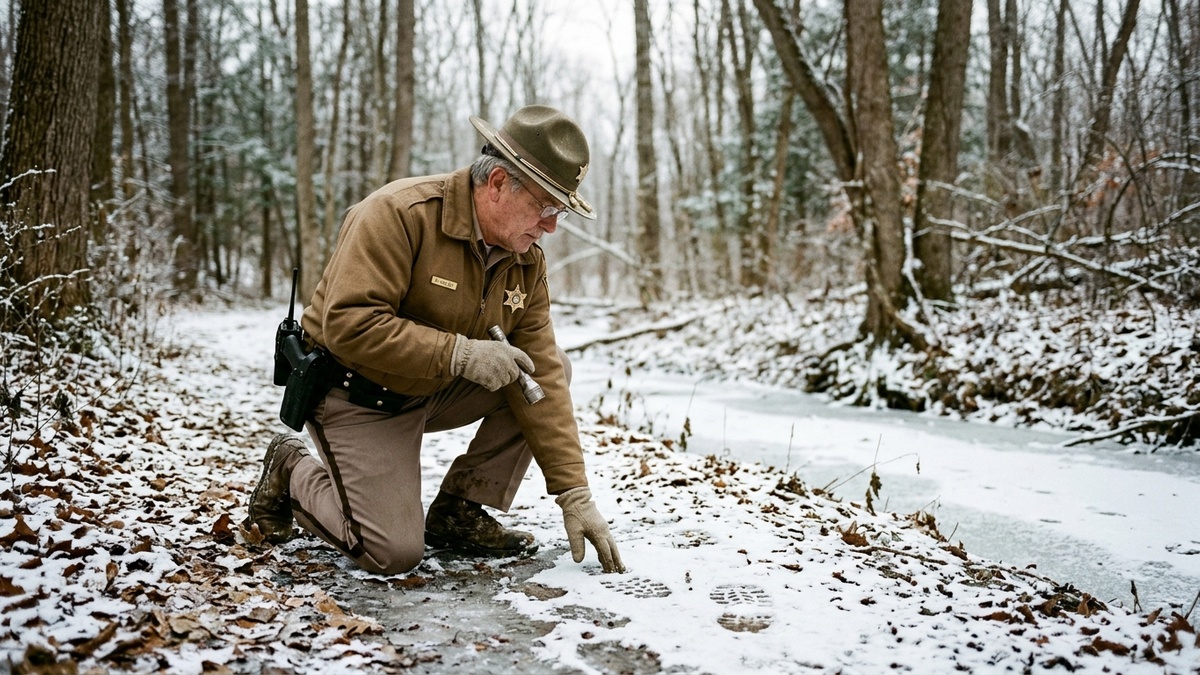
For forty-four years, Lavonne Tuttle's pecan sacks had weighed the same at her barn as they did at the buying station on Highway 9, and this December, all of a sudden, they didn't.
Not by much. Three pounds on a sixty-pound sack. Four on another. The young man running the scale, a cheerful fellow named Travis Kemp, wrote down the numbers in his ledger and said, "Dry year, Miss Lavonne. They lose water weight in the barn."
Lavonne looked at the scale. Then she looked at the sacks.
"Not my pecans," she said.
"Ma'am?"
"My pecans don't lose water weight in the barn. They lose it on the tree, before I ever pick them up." She took her check and folded it twice. "I'll be back Thursday with the rest."
Lavonne was seventy-six. She and her late husband, Dub, had planted the pecan grove on the river bottom outside Pecan Bend, Oklahoma, in 1981, three hundred trees in rows as straight as church pews. Dub had died in March. This was her first harvest alone.
Her daughter, Sherry, had driven down from Tulsa in October to help. Sherry was fifty and worked in a bank. She had come home intending to stay two weeks. She had been there seven.
"Mama, let it go," Sherry said that night at the kitchen table. "It's a few pounds. Dub always said Kemp's daddy was honest."
"Kemp's daddy was honest," Lavonne said. "Kemp's daddy retired in August."
Dub Tuttle had kept an old balance-beam scale in the pecan barn. It was the kind with a sliding brass weight on an iron arm, painted green, made sometime before the war. He had bought it at a farm sale in 1983 for eleven dollars. Every sack that left the Tuttle place, he weighed on that scale first and wrote the weight on a paper tag tied to the sack with twine.
"You weigh it twice," Dub used to say. "Once for you and once for the buyer. If they ever disagree, you know who to ask."
Lavonne had kept doing it after he died, out of habit and out of missing him. She went out to the barn that night with a flashlight and found the tags.
Every sack she had sold that season had a tag. Every tag was in her own handwriting. And every sack had come up short at the buying station by three or four pounds.
On one sack, it was the difference between her number and his number on the same day.
She did the arithmetic on the back of an envelope. She had sold a little over six thousand pounds so far. At three and a half pounds a sack, that was close to three hundred and fifty pounds she had been paid nothing for. At this year's price, it came to several hundred dollars.
From one grower.
And there were forty growers on that river who sold to Kemp's station.
Thursday, she went back with eight more sacks. She had weighed each one twice on Dub's scale. She had tied each tag with a double knot.
Travis Kemp weighed them. Every one came up short.
"Dry year," he said again, smiling.
"Travis, honey, I'd like you to weigh one more thing for me," Lavonne said.
She reached into the bed of her pickup and lifted out a fifty-pound sack of sweet feed from the co-op, still sewn shut at the top, with the weight printed on the side.
"What's this for?"
"Just humor an old woman."
He set it on the scale. The scale read forty-six and a half.
Travis looked at the reading. His smile stayed on his face, but something behind it went stiff.
"That's a feed sack," he said. "The co-op shorts those all the time."
"The co-op has been weighing feed since 1946," Lavonne said. "I'll take my pecans home, please. All eight sacks."
She told Sherry that night. Sherry did not laugh this time.
"Mama, that's fraud," she said. "If he's doing that to every grower on the river."
"I know what it is."
"You need to call somebody. The state. The sheriff."
"And tell them what? That an old widow's eleven-dollar scale disagrees with his? He'll say mine's off." Lavonne poured herself a cup of coffee. "Dub's scale was off once, in 1991. A mouse built a nest in the beam. Kemp's daddy fixed it himself."
Sherry stared at her. "So what are you going to do?"
"I'm going to find out how he's doing it," Lavonne said. "Then I'll know who to call."
Saturday morning was the busiest day at the buying station. Growers lined up their pickups along the highway with sacks in the beds. The air smelled of dust and pecan hulls and burned coffee.
Lavonne parked at the end of the line and walked up to the window of the little office by the scale. She did not bring pecans. She brought a thermos and a lawn chair and sat down in the shade of the building, where she could see both the scale platform and the back of Kemp's office through the window.
She watched for two hours.
At a quarter to eleven, she saw it. Every time a pickup pulled up, Travis went inside the office for a moment before he weighed. Every time a farmer from out of town pulled up, or a young grower he didn't know, he stayed outside.
She stood up, folded her chair, and walked around behind the building.
Through the back window, she could see the electronic readout box for the scale, mounted on the office wall. Beside it was a small black remote, the kind you use to open a garage door. And on Travis Kemp's desk, half under a pile of invoices, was a second ledger she had never seen before.
She was leaning close to the glass, reading the name on the first page, when the back door of the office opened, and Travis Kemp stepped out and stopped two feet from her.
"Miss Lavonne," he said, very quietly, and the cheerful voice was gone. "You need to go home now."